
India's fiscal deficit has crossed the government's initial estimate of 2.5 per cent of Gross Domestic Product in the eight months up to November 2008.

The Centre's fiscal deficit at the end of the eighth month of financial year 2024-25 touched 52.5 per cent of the full-year target, government data showed on Tuesday. In absolute terms, the fiscal deficit -- the gap between the government's expenditure and revenue -- was about Rs 8.47 lakh crore during the April-November period, according to the data released by the Controller General of Accounts (CGA).

'For OTT platforms, securing dubbed rights often makes greater business sense, enabling them to serve diverse regional audiences more effectively.'

The road ahead will require navigating complex financial challenges while fostering job creation and sustainable development in the region.

Experts say the state's economy is grappling with hidden debt, rising welfare costs, and lack of transparency.

India's $280-billion IT industry heads into 2026, balancing visa-related headwinds and global trade uncertainty against its biggest-ever push into artificial intelligence and the rapid expansion of global capability centres (GCCs). Heightened scrutiny of the US H-1B visa programme - including a proposed $100,000 fee for new visas and concerns over a potential 25 per cent outsourcing tax - has complicated cross-border delivery for Indian firms, even as companies accelerate efforts to reduce reliance on onsite staffing.

'...not merely in managing fiscal mathematics, but in demonstrating conservatism and prudence within that framework.' 'Looking forward, we believe sufficient growth drivers exist -- ranging from government reforms to revival in consumption to favourable monsoons. Numerous factors support the Indian economy.'

'We expect inbound numbers in 2025 to come close to pre-pandemic levels -- if not fully match them -- by early 2026.'

Geopolitical tensions, trade policy uncertainties, volatility in international commodity prices and financial market uncertainties pose considerable risks to India's economic growth in the coming year, the finance ministry cautioned on Wednesday. "Global trade continues to be affected by uncertainty in the policy environment... tariff-related developments in multiple countries have heightened trade-related risks, affecting investment and trade flows globally.

All eyes will be on whether Sitharaman provides the much-expected tax relief for the middle class, leaving more money in their hands, as there is tax buoyancy

Amid the Budget preparation, the revenue department is assessing the feasibility of further adjustments to maximise benefits for salaried individuals.

Seven of the meetings will be held in late November or early December at the finance ministry, as is the norm.

Pakistan suffered an 85 per cent loss after spending Rs 869 crore for hosting the Champions Trophy 2025.

Even by conservative assumptions that 5 to 10 per cent of infected individuals develop long Covid, India today may be home to 50 to 100 million infected individuals -- many silently coping with breathlessness, fatigue, palpitations, brain fog, or unexplained clotting tendencies.

For fiscal year FY23, the 2022 Union Budget had targeted a capex outlay of Rs 7.5 trillion, which is 35.4 per cent higher than the FY22 Budget Estimate of Rs 5.54 trillion.

Continuing on the fiscally prudent path, the Modi government in the interim Budget refrained from announcing populist measures, which will help it trim the fiscal deficit to 5.1 per cent of the GDP next fiscal and 4.5 per cent in FY26.

The government's indirect tax collection is expected to increase by 8.3 pc in the financial year 2025-26 (FY26), according to a report by ICICI Bank. The report also noted that this growth is higher than the 7.1 per cent increase seen in FY25 and is mainly driven by rise in GST revenue from strong urban consumption. It said "The increase is driven by higher goods and services tax collections which in-turn is explained by boost to urban consumption".

Finance Minister Nirmala Sitharaman will be presenting her fifth Budget that may do a tightrope walk between staying fiscally prudent and meeting general public expectations of lower taxes and a wider social security net, while at the same time firing the engines of the economy.

Net direct tax collection in the eight months of the current fiscal touched 58.34 per cent of Budget Estimates (BE) at Rs 10.64 lakh crore. The net tax collection for April-November stood at Rs 10.64 lakh crore, which is 23.4 per cent higher than the corresponding period of last year, the ministry of finance said.

Instead, 2019-20 could be the base from which the Budget estimates for next year are calculated.

After the disappointment of War 2, there was some respite this weekend as Param Sundari managed to have a decent opening at the box office.

The finance ministry will kick-start the exercise to prepare the Union Budget for financial year 2022-23 (FY23) from October 12, according to an official notification released on Monday. "The pre-Budget meetings as well as the meetings to discuss the revised estimates will start from October 12 and will continue till the second week of November," according to the Budget circular of the Department of Economic Affairs' Budget Division. The Union Budget is expected to be announced on February 1, as has been the practice of the past few years.

If the fiscal deficit target of 4.9% of GDP has to be met for 2024-2025, which the government must in view of the uncertainties and challenges emerging both domestically and globally, the finance ministry may see in the composition of the current year's capex a sliver of hope, notes A K Bhattacharya.

"Commonwealth Games in India would leave lasting impact by boosting tourism, and creating jobs, the Government said in a statement.

Pre-Budget excercise next month should scrupulously avoid adventurism of all types and refrain from making excessively ambitious projections on revenue and expenditure numbers for 2023-24, suggests A K Bhattacharya.

Ask rediffGURU and PF, MF and insurance expert Purshotam Lal your mutual fund, insurance and personal finance-related questions.

Commonwealth Sport's EB recommends Ahmedabad as host for 2030 CWG

Union Finance Minister Nirmala Sitharaman on Saturday announced a fresh Rs 15,000 crore 'SWAMIH Fund' for completion of 1 lakh units in stalled housing projects across various cities, a move aimed at providing relief to distressed homebuyers whose investments are stuck. In November 2019, the Centre announced a stress fund named 'Special Window for Affordable and Mid-Income Housing' (SWAMIH), to complete stalled housing projects across India.

>According to the latest RBI data, PPF receipts have already experienced a decline between April 2023 and February 2024. Other schemes like the Sukanya Samriddhi Account and National Savings Certificate are also witnessing reduced inflows.
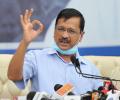
Sources in the Delhi government said the ministry of home affairs has stopped the Kejriwal government's budget and it will not be tabled in the assembly on Tuesday.

Amid speculations of partial roll back of stimulus in the upcoming Budget, a key finance ministry official said the government's kitty from indirect tax collections will fall short of the projected figures for this fiscal.

With the reality of coalition politics staring the BJP in its face, this was inevitable, points out Ramesh Menon.

If this happens, it will be an "unprecedented development" in the civic body's journey as budget is traditionally passed by a House, they said.

The Union government's revenue from securities transaction tax (STT) is on track to exceed its Budget projection for the current fiscal year, with the mop-up already surpassing 50 per cent of the annual estimate. Provisional figures reveal that the Centre has collected approximately Rs 14,000 crore in the first half of this fiscal year up to September, according to a government official. This amount exceeds half of the full-year target of Rs 27,625 crore set for FY24.

As per the Interim Budget 2024-25 document tabled in the Lok Sabha, the government is not expected to receive any money from monetisation of public assets in the current fiscal.

The finance minister's assertion that industry should not expect any spectacular announcements in the 2024 interim Budget suggest that the electoral imperatives of more tax concessions or higher expenditure on welfarist programmes could be far less pronounced than they were before the 2019 interim Budget, expects A K Bhattacharya.

Domestic rating agency Icra on Wednesday said India's real GDP growth for the September quarter is likely to decline to 6.5 per cent due to heavy rains and weaker corporate performance. The agency, however, maintained its FY25 growth estimate at 7 per cent on expectations of a pick up in economic activity in the second half of the fiscal.

Hero MotoCorp and TVS Motor crossed Rs 1,000 crore in R&D spend for the first time, as legacy OEMs accelerate innovation to compete with new-age EV players.

The defence budget was on Thursday increased to Rs 6.21 lakh crore for 2024-25 in a modest hike of 4.72 per cent from last year's allocation of Rs 5.25 lakh crore amid India's continuing border row with China in eastern Ladakh as well as concerns over evolving security situation in the strategic waterways.
